
Call us now :08045479896
 Send Inquiry
 Send Inquiry
TWO WHEELER PETROL ENGINE OF DIFFERENT MAKES IN RUNNING CONDITION
MOQ : 1 Unit
TWO WHEELER PETROL ENGINE OF DIFFERENT MAKES IN RUNNING CONDITION Specification
- Stand Type
- Engine mounting frame with wheels (movable, for demonstration)
- Shaping Mode
- Assembled 2-wheeler petrol engine units
- Material
- Metal alloys (Aluminium, Steel, Cast Iron)
- Product Type
- Two Wheeler Petrol Engine (in Running Condition)
- Mould For
- Educational/Training purpose
- Mould Size
- Varies (typically compact, as found on 2-wheelers)
- Mould Material
- N/A (Actual engine, not a mould)
- Design
- OEM design, various makes
- Quality
- Standard quality, fully functional units
- Displacement
- 90cc to 150cc (brand dependent)
- Maximum Power Output
- 6.5 13 HP (varies with model)
- Demonstration Features
- All major engine operations observable under safe running condition
- Fuel System
- Carburetor or Fuel Injection (as per make/model)
- Weight
- Approx. 45-60 kg (assembled unit with stand)
- Ignition System
- CDI / Magneto depending on model
- Number of Cylinders
- Single Cylinder
- Starting System
- Kick Starter and/or Electric Starter
- Transmission
- Manual (4-5 speed) or Automatic (CVT, as per make)
- Brand Options
- Bajaj, Hero, Honda, TVS, Yamaha, etc.
- Display
- Mounted on frame for demonstration in running condition
- Accessories
- Complete with controls, exhaust, fuel tank, wiring, and display stand
- Cooling System
- Air-cooled
- Application
- Laboratory, technical training, educational demonstration
- Engine Type
- 4-stroke and/or 2-stroke petrol engine (various brands)
TWO WHEELER PETROL ENGINE OF DIFFERENT MAKES IN RUNNING CONDITION Trade Information
- Minimum Order Quantity
- 1 Unit
- Payment Terms
- Telegraphic Transfer (T/T), Western Union, Paypal, Cheque
- Supply Ability
- 100 Units Per Week
- Delivery Time
- 1 Week
- Main Export Market(s)
- Australia, North America, Eastern Europe, Middle East, Africa, South America, Western Europe, Asia, Central America
- Main Domestic Market
- All India
About TWO WHEELER PETROL ENGINE OF DIFFERENT MAKES IN RUNNING CONDITION
TWO WHEELER PETROL ENGINE OF DIFFERENT MAKES IN RUNNING CONDITION
The petrol engine setup will be prepared by using good working condition engine with all the fittings of the engine along with silencer, air filter, fuel tank ,electrical wiring with ignition switch etc., all mounted on to a sturdy iron frame with caster wheels (mobile trolley) .
All the fittings such as fuel tank, etc., along with the engine will be arrange on to the paint finished trolley with its original fittings such as rubber dampers and clamps so as to contain the vibrations.. The engine assembly will be serviced ,painted with a single colour paint.
| MT-V01 | Bajaj Chetak Engine assembly |
| MT-V02 | Suzuki Samurai Engine assembly |
| MT-V03 | Yamaha engine assembly |
| MT-V04 | TVS super XL (Electronic Ignition Engine) |
| MT-V05 | Bajaj Pulsar 150 CC Engine assembly |
| MT-V06 | Hero Honda Engine assembly |
Comprehensive Engineering Demonstration
Our display units allow students and trainees to explore the complete working process of petrol engines, including ignition, fuel supply, cooling, and transmission functions. The set-up ensures safety while enabling direct observation and manipulation of engine controls for better understanding of technical concepts.
Wide Range of Brands and Specifications
Engines from leading manufacturers such as Bajaj, Hero, Honda, TVS, and Yamaha provide variety and realism in training. You can select between 4-stroke or 2-stroke configurations, differing in displacement, transmission type, and fuel system, offering true-to-life insights into modern two-wheeler engines.
Ideal for Educational Institutions
Specially designed for engineering labs, technical colleges, and vocational institutes, these engine units come ready for classroom demonstration and hands-on practice. Their sturdy, movable frames and complete assembly make them easily accessible and highly useful for repeated educational applications.
FAQs of TWO WHEELER PETROL ENGINE OF DIFFERENT MAKES IN RUNNING CONDITION:
Q: How is the two wheeler petrol engine set up for educational demonstrations?
A: Each engine is securely mounted on a movable display frame, complete with all necessary controls, exhaust, fuel tank, wiring, and safety features. This setup enables direct observation and manipulation while maintaining operational safety in laboratory and classroom environments.Q: What brands and engine types are available for demonstration units?
A: Demonstration units are available in both 4-stroke and 2-stroke petrol engine configurations from popular brands such as Bajaj, Hero, Honda, TVS, and Yamaha. Each model varies in displacement, ignition system, and transmission type as per manufacturer specifications.Q: When should these engine units be used in technical training?
A: These units are best utilized during practical sessions and technical courses where students need to witness and understand actual engine operation, troubleshooting, or maintenance processes. This hands-on approach enhances theoretical learning in engineering and vocational programs.Q: Where can the running condition engine display be installed?
A: The units are designed for use in classrooms, laboratories, training workshops, and technical institutes. Their compact size and movable frames allow flexible placement to suit various demonstration and instructional needs.Q: What is the process for observing engine operations?
A: All major engine operationsstarting, running, control of ignition, fuel system, cooling, and transmissioncan be safely observed by activating the controls and watching internal and external mechanisms under live running conditions. Instructors can highlight specific cycles and processes for educational clarity.Q: How does the demonstration unit benefit students?
A: Students gain practical experience and clear understanding of engine mechanics, real-world maintenance, and troubleshooting. Direct engagement with fully functional units prepares learners for careers in automotive engineering and technical fields with enhanced skills and confidence.Q: What safety measures are included during engine demonstration?
A: The engine and its components are mounted on a sturdy frame with protective covers, enabling safe operation. Safety protocols are followed to prevent accidental contact and the inclusion of exhaust and control systems keeps emissions and hazards in check during demonstrations.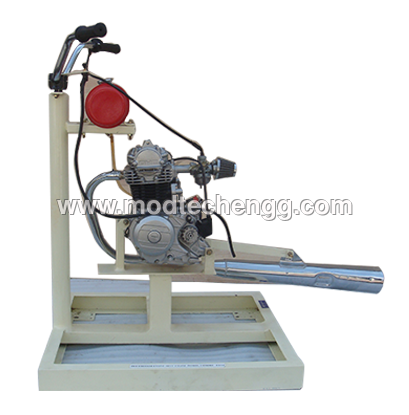
Tell us about your requirement

Price:
Quantity
Select Unit
- 50
- 100
- 200
- 250
- 500
- 1000+
Additional detail
Mobile number
Email


 Send Inquiry
Our Products
- Cut Section Complete Chassis With Electricals
- Cut Section Complete Chassis Without Electricals
- MODEL OF ENGINE ASSEMBLY WITH CLUTCH & GEAR BOX
- CUT SECTION MODEL OF ENGINE
- Engine Assembly with Clutch & Gear Box
- CUT SECTION MODEL OF TWO STROKE SINGLE CYLINDER DI
- Cut section Model Of Gear Box
- Cut section Model of Steering Gear Box
- Cut Section Model of Clutches
- Cut Section Model of Differential with Rear Axle
- Cut Section Model of Brake System
- Cut Section Model of Electrical System
- Cut Section Model of Fuel Supply System
- Cut Section Model Of Suspension System
- Cut Section Model Of Lubrication & Cooling System
- Cut Section Model Of Different Small Components
- Four Stroke Petrol Carburettor Engine For Practice
- Four Stroke Petrol Mpfi Engine Setup For Practice
- 4 Stroke Petrol Carburator Engine With Lpg Setup
- Four Stroke Petrol Mpfi Engine With Lpg Setup
- Four Stroke Diesel Engine Setup
- Two Wheeler Petrol Engine Of Running Condition
- Instruction Boards/Training Platforms
- Training Module For The Engines
- Test Rigs
- Cut section model Of Complete Vehicle
- Cut Section Model Of Engine Working
- Cut section Model Of Different Automobile Parts
- Cut Section Model Of Two Wheeler Aggregator
- Practice/ Running Engine Setup
- Tool And Equipments
- Model Of Auto Electricals
- Garage Tools & Equipments
- Cut Sectioned Engine Assembly With Clutch & Gear
- Exhibition Models

Plot No. 95, Behind Omex Auto, Bommasandra Jigani Link Road, Jigini Post, Bengaluru - 562105, Karnataka, India

Mr Sunil J.
(Partner)
Mobile :08045479896
 Send Inquiry
 Send SMS
Developed and Managed by Infocom Network Private Limited.
